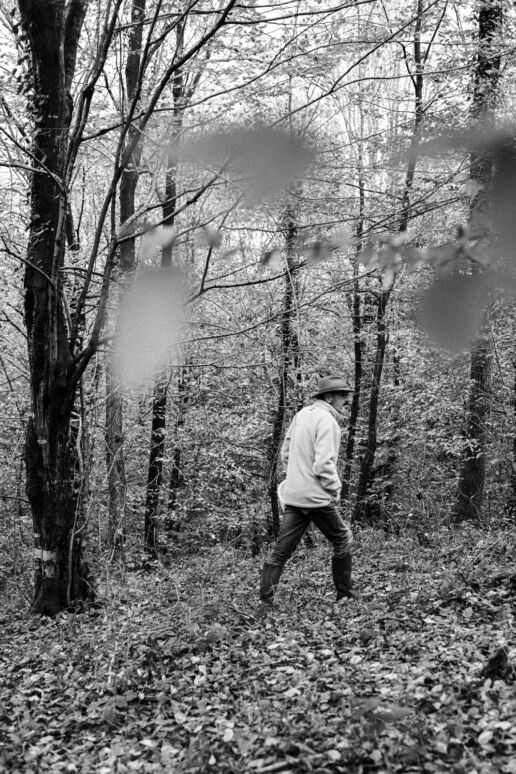

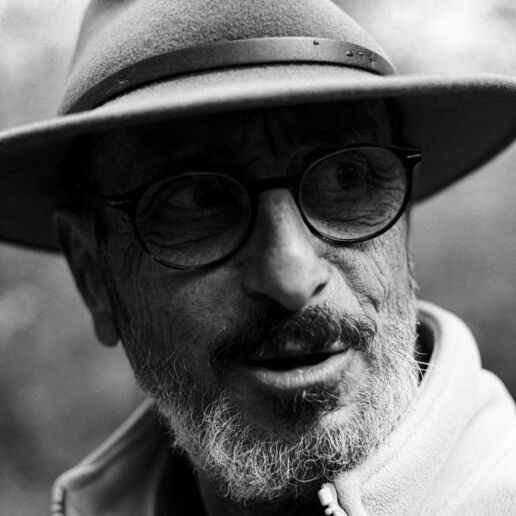
JİLBER BARUTÇİYAN
Jilber Barutçiyan is Turkiye’s first mycologist and the most recognizable figure in the world of mushrooms. His curiosity turned into a hobby and over time that hobby became a passion. Drawing more people into his world every year, Barutçiyan shares with us the Istanbul he carries with nostalgia and his relationship with the realm of fungi.Photography Nazlı Erdemirel
PAPER Which neighborhood of Istanbul did you grow up in and what was your childhood like?
JB I grew up in Kadıköy. Back then it wasn’t smothered in concrete like it is today. The sea was abundant, the surroundings were green. Being a child of the 60’s meant growing up in an environment where the streets were your playground. Both my mother and father loved the sea and the forest. Within the natural flow of my childhood, my closeness to nature developed spontaneously.
P How did studying at a boarding school in the middle of the city affect your relationship with nature?
JB I studied at Galatasaray High School. I loved Beyoğlu of that era and still carry its nostalgia. Cosmopolitan life, cultured people coming together… When we went to Artistler Kahvesi, Kemal Sunal (one of Turkey’s most beloved film actors and comedians) would teach us bridge. When we went to Papirüs Bar, Tarık Akan (a prominent Turkish film actor) would talk to us about scuba diving and revolutionary ideals. Özdemir Asaf (a highly influential Turkish poet and writer) was like an uncle to us. We lived in such an interesting environment. At a young age, I didn’t have a particular urge to escape to nature but I was involved in scouting, scuba diving and fishing.
P Could you tell us about the coincidental beginning of your interest in mushrooms?
JB I went to Switzerland at an early age. It has a beautiful forest structure. There I realized that mushroom foraging was almost like a national sport. Right after the rain, everyone; children, adults, young and old, would head into the forest to collect mushrooms. I got curious. You know how it usually starts: “Let me learn one or two species so we can eat them.” I said the same, but then I realized the subject was quite broad and complex. As I kept saying, “Let me learn this one too, and that one,” it turned into a hobby. Then it grew stronger and became a passion. Eventually, I couldn’t imagine not going mushroom hunting.
P Could you describe the process by which your curiosity led you to expertise?
JB Today, mycology no longer has a university-level chair anywhere in the world, the last one closed in the 1950s. For this reason, those who keep this science alive come from very different professions. Among us are medical doctors, lawyers and carpenters.
Switzerland’s position within this diversity is quite special. A hundred years ago, an institution was established under the Ministry of Health to inspect mushrooms sold in the country or served in communal kitchens and to prevent poisonings. After attending its courses for many years, I was finally admitted to the pre-exam class after 24–25 years. It was a very long process. At that time, I was already planning to return to Turkiye but I also applied for the exam to test myself. I passed and became a mushroom expert certified by the Swiss Ministry of Health.
P When you returned permanently to Istanbul years later, how did the city make you feel?
JB My connection with Istanbul never broke. Even during the years I lived in Switzerland, I came frequently and enjoyed the city. Istanbul is a very pleasurable place when you visit on holiday.
After my permanent return, I began living in İstinye, close to the forest. Later, to avoid city life, I moved to Adatepe and then to Gökçeada. Now I only spend mushroom seasons in Istanbul.
P How would you describe the world of mushrooms in Istanbul – from the poisonous to the most valuable?
JB Turkey is an extremely rich country in terms of mushroom productivity compared to others in its climatic belt. Istanbul is a special ecosystem in itself; it’s also very rich in bird and fish diversity. Thanks to its northern forested areas, it receives the effects of the Black Sea climate and gets ample rainfall, which is the most basic need for mushrooms. The city has great biological diversity, and naturally, this diversity is reflected in its mushrooms as well.
P How did your journey of turning Turkiye’s mushrooms into books unfold?
JB Shortly after becoming an expert in Switzerland, I returned to Turkiye. When I entered Belgrad Forest after the first rain, I encountered an incredible richness. Mushrooms that I had chased for 25 years in Europe were growing here in abundance, generation after generation. Moreover, it seemed as though no work had been done in this field at all. That’s how the idea for the first book was born.
Instead of saying, “I learned this in Europe, let me tell you,” I wanted to create an entirely original work. Together with Mehmet Akgül, one of the founders of İFSAK, we spent years trekking across mountains and valleys, from the Kaz Mountains to the highlands of Giresun, from Istanbul’s forests to the Taurus Mountains. We compiled the six years of fieldwork into the book Mushrooms of Turkiye, and later published a more advanced version.
P In a lifetime spent with mushrooms, what experience transformed you the most?
JB Even someone going for the first time can feel that focusing on mushrooms after stepping into the forest is a form of meditation. Nothing related to daily life comes to mind; you concentrate and leave the forest genuinely rested. As a friend of mine once said, we don’t tell people, “Eat mushrooms, they’re healthy”. After all, we’re not medical professionals. For us, the most health-giving aspect of mushrooms is going out to collect them.
P Could you tell us about the mushroom tours you organize in the forest?
JB Mushroom season in Istanbul actually lasts about two to three months. We also give trainings in places like İğneada, Kastamonu, Bolu and Uludağ. In Istanbul, the organization of the mushroom tours is undertaken by Casa Lavanda. Lavanda’s chef, Emre Şen, is a highly skilled name with a Michelin background, strong both creatively and in classical cuisine. I can comfortably say it’s one of the kitchens in Turkiye that uses truffles in the most accurate way.
During the tours, I ask participants to collect samples. If an edible mushroom ends up in the basket, it’s theirs; the others we display. Most people, of course, want to learn edible species first, but my primary responsibility is to teach dangerous mushrooms. For example, if you don’t know the death cap, you shouldn’t go mushroom foraging, the result can be fatal. For those who can’t go into the field, I also give lectures at schools and universities. Additionally, we prepare menus together with many restaurants and chefs. We explain the characteristics of mushrooms and also let participants taste them.
P Where do you feel best in Istanbul, are there places that draw you in?
JB Thanks to mycology, I’ve become friends with almost all the major chefs, so I’m lucky in that respect. But at a certain age, you start to look a bit more toward nostalgia. I have only one place to eat fish on the Bosphorus. When I go to Beyoğlu, I don’t wander much, I go straight to Jash, without question. He’s both a friend and I adore his food. There’s Tombul’s Meyhanesi in Büyükdere, which I love. Seeing Galatasaray High School makes me happy. In our youth, my father used to talk about old Beyoğlu; now we do. Today’s young people will one day refer to this era as “old Beyoğlu.” Change is inevitable.
P Could you tell us about the book you are currently working on?
JB My first book, Mushrooms of Turkey, included 200 species. Then Macro Fungi, which examined 350 species in greater detail, was published. After that, together with Çağnam Erkmen, we wrote Mushroom Hunting in Istanbul for children. A few months ago, Macro Mushroom Poisonings, which I prepared with Afife Mat, was published. I’ve also contributed to many other books. At the moment, we’re working on two projects: one is a gastronomy book focused on mushroom dishes and the other is an illustrated pocket guide. We’re preparing a practical guide so people don’t have to go into the forest with a huge book but can find their way with just a few pages.